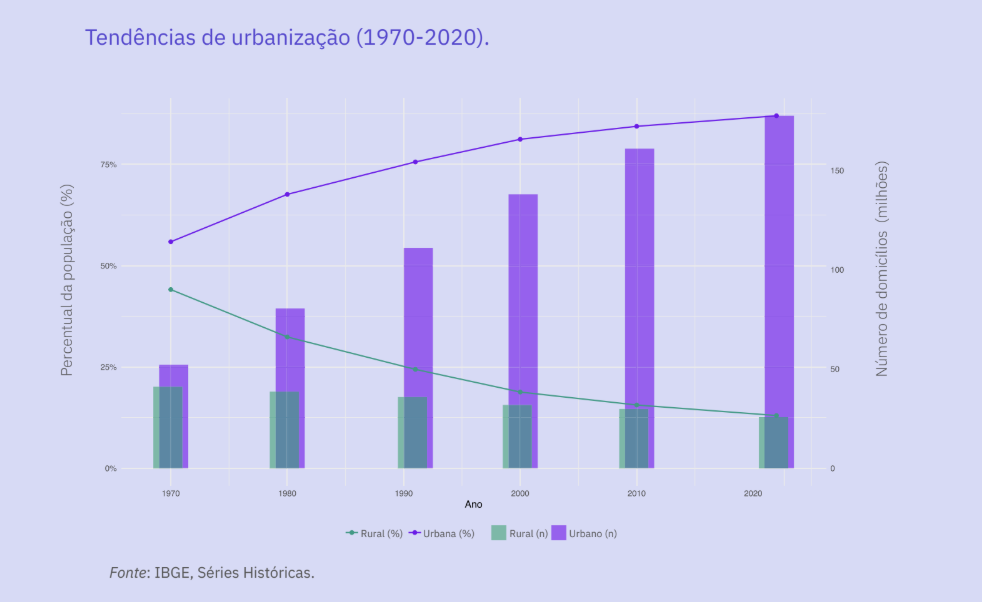
To promote transformative actions at the local level, Brazil must build a new paradigm of urban development, capable of simultaneously addressing the challenges of the climate emergency and the historical inequalities that mark the national territory. With more than 871,300 of the population living in urban areas (IBGE, 2023), the country intensely expresses the contradictions and potentialities of the contemporary urban phenomenon: on the one hand, it concentrates most of the economic activity, innovation, and production of public policies; on the other hand, it bears the marks of socio-environmental vulnerability, territorial segregation, and inequality in access to basic rights.
Understanding this context is essential for strengthening fair and effective climate policies. Brazilian urbanization occurred rapidly and unevenly, resulting in a mosaic of cities ranging from large metropolises and medium-sized regional cities to small urban centers with strong rural ties—typologies that reflect different institutional and economic capacities, as well as environmental dynamics (Ministry of Cities, 2025).
This territorial diversity highlights that responses to the climate crisis need to be considered in a contextualized way, respecting local specificities and regional dynamics.
Within the context of Brazilian urban and socio-spatial dynamics, it is important to highlight that the term "city" is not necessarily limited to the territory delimited by the "municipality." According to the Ministry of Cities (2025), a city is understood as a functional territorial unit defined by the socio-spatial and economic interactions that structure the daily lives of the population. Thus, a city may correspond to a single municipality or may be formed by more than one municipality with strong integration between them. These socio-spatial relationships are fundamental to qualifying the exposure and vulnerability of cities to climate risks, as well as for the search for joint definition, or not, of institutional arrangements and adaptation and mitigation actions among municipalities.
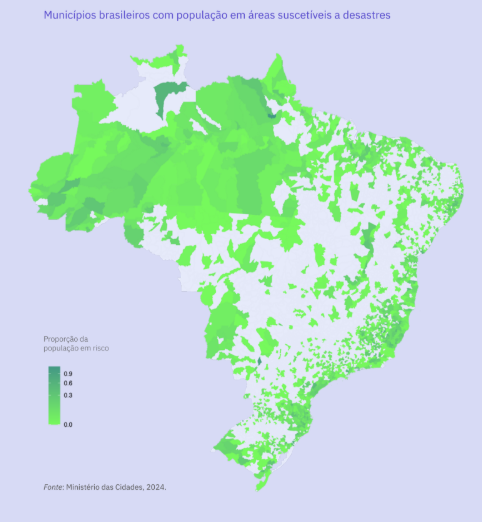
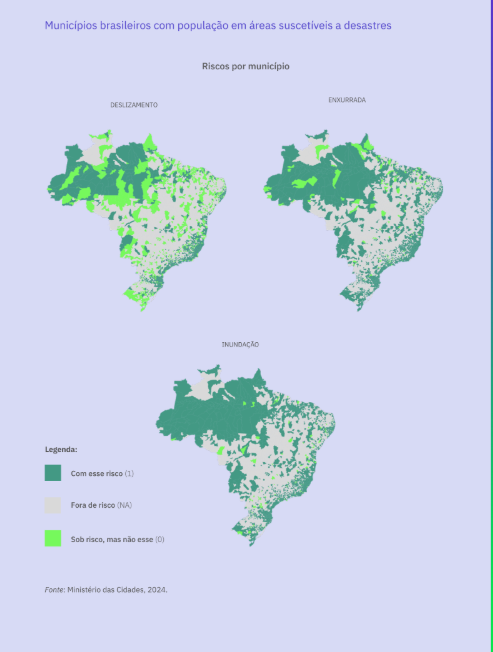
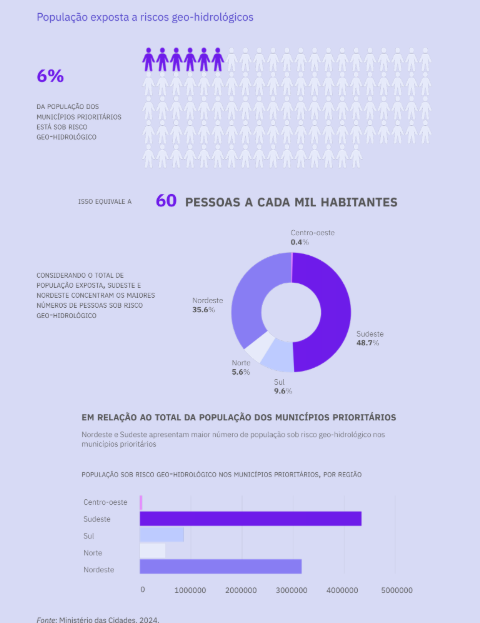
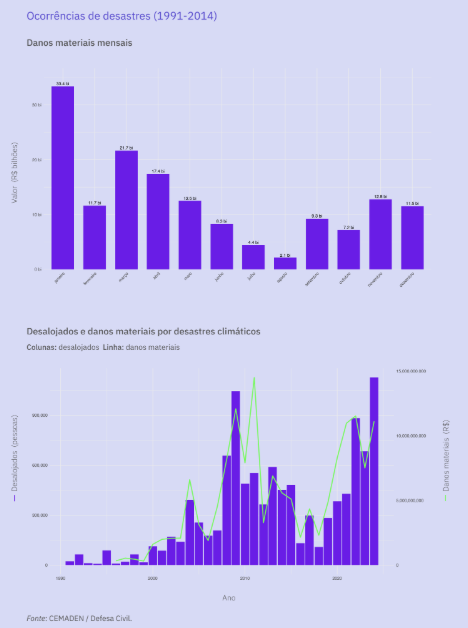
In the context of a climate emergency, the country faces a growing scenario of extreme weather events—floods, droughts, landslides, and heat waves—which, in 2024 alone, caused R$ 45 billion in economic losses and directly impacted 8.9 million people (CNM, 2024). These numbers reveal the urgency of strengthening federal governance, data integration, and the response capacity of municipalities to climate risks.
The section "The Brazilian Urban Context" presents this overview using infographics and thematic maps, which summarize the main urban trends and vulnerabilities in the country.
By combining population, economic, and environmental data, the aim is to offer an integrated understanding of Brazilian urban territories and their socio-spatial dynamics, guiding the planning of subnational actions aimed at transitioning to more just, resilient, and low-carbon cities.


 English
  Portuguese