HomeArticleThe Impact of Construction Rights on Climate Change Mitigation and Adaptation in the Urban Transformation Structuring Network of the City of São Paulo: Historical Analysis and Future Scenarios
The Impact of Construction Rights on Climate Change Mitigation and Adaptation in the Urban Transformation Structuring Network of the City of São Paulo: Historical Analysis and Future Scenarios
Between 70% and 80% of global air pollutant and CO2 emissions come from urban areas. In addition to bearing increasing responsibility for their causes, cities are also the ones that suffer most from their effects and, in particular, are the areas of greatest social and environmental vulnerability.
In Brazil, most greenhouse gas (GHG) emissions in 2019 were caused by land-use changes and the agricultural sector, responsible for 44% and 19%, respectively. The energy sector, despite ranking third with 19%, saw the largest increase in emissions in the last 20 years, reaching almost double the contribution recorded since 1990 (IEMA, 2020). Most of this increase was due to the expansion of the country's car and truck fleets. In the state of São Paulo, for example, the energy sector accounted for approximately 57% of GHG emissions (CETESB, 2011), with the transportation subsector also accounting for a large portion of this increase.
This scenario could worsen further. Projections for 2030 reveal that, if the disorderly urbanization model of cities, which has led to the precarious occupation of environmentally protected areas, is not reversed, floods with significant runoff and landslide potential will become even more common.
This will further affect low-income populations living in environmentally vulnerable areas, according to Nobre (2010). To address this challenge, the city of São Paulo adopted a Climate Change Policy in 2009. Regarding land use, the compact city principle stands out, with the economic incentives section providing incentives for buildings that promote the reduction of GHG emissions through construction rights.
Construction royalties are the financial charges paid by new developments to offset the negative externalities generated by the intensification of land use. This charge is paid on the additional building potential utilized, defined by the difference between the basic and maximum coefficients established by municipal urban legislation.
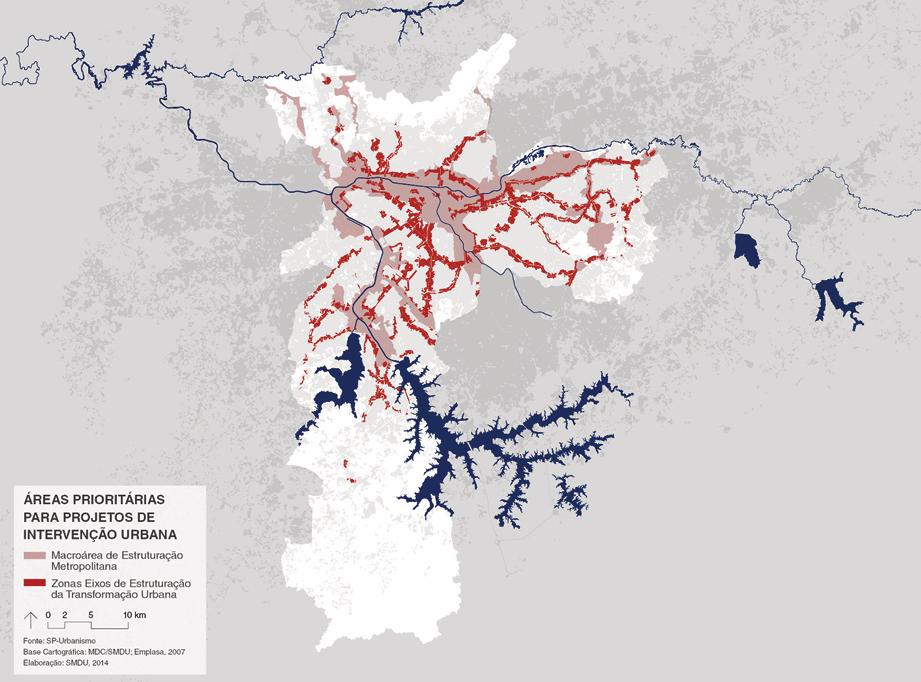
The Strategic Master Plan (PDE, 2014) and the Land Division, Use, and Occupation Law (LPUOS, 2016) were a turning point in São Paulo's urban management toward a Sustainable Transportation-Oriented Development (TOD) policy. According to this new legislation, strategic zones along medium- and high-capacity public transportation corridors (the metro-rail system and exclusive bus lanes, both existing and planned) were designed to concentrate population density and the expected job growth over the next 16 years. Two main elements were recognized in these areas oriented towards urban transformation: (i) the Metropolitan Structuring Macro-Area (MEM), where the underutilized industrial park, well-served by infrastructure systems and strategically located, should be reconfigured through Urban Intervention Projects (PIU); and (ii) the Urban Transformation Structuring Axes (EETU), where the aim was to link construction densification with the improvement of real estate production, to create a more balanced relationship between buildings and the city. Both elements were then combined as part of the Urban Structuring and Transformation Network (RETU) (Figure 01).
The Urban Transformation Structuring Network (RETU) is the subdivision of the city's territory where the guidelines for the greatest optimization of land use are in place, allowing it to achieve the highest Utilization Coefficients, limited to four times the area of the computed land. There are different instruments in force for recovering real estate appreciation, whose construction rights charges are reverted to different urban development funds. While the Consortium Urban Operation (OUC), whose application should be restricted to the MEM, adopts the Certificates of Additional Construction Potential (CEPAC), construction rights auctioned on the Stock Exchange, the Onerous Grant of Construction Rights (OODC) instrument applies to the remaining areas of the city. The OODC has a distributive objective, since the resources collected in higher-value areas can be distributed throughout the city. In the OUC, however, the resources can only be applied within the territorial limits defined by the laws regulating their specific Urban Projects.
The resources obtained through these instruments must be invested in the expansion and qualification of Urban and Environmental Systems, through projects to expand the drainage system, implement new green areas and promote sustainable mobility (Public Transport, Cycle Paths and Sidewalks), for example.
Relate the policy of collecting and investing in building rights with the strategies for mitigating and adapting to climate change in the RETU of São Paulo is the objective of this work, which was structured in two phases.
We will present each of them.
The first consists of a historical analysis that aims to evaluate how resources collected through land value capture instruments are applied in relation to the climate dimension, and the second deals with the formulation of future scenarios that aim to identify how the projected capacity of resources with these instruments can contribute to investments so that São Paulo becomes a low-carbon city.
The scenario forecasting methodology was adopted based on data collected from municipal and market sources. The analysis focused on land use and fiscal impacts, which, in turn, result in different climate change and investment possibilities for adaptation. Three different scenarios were developed: (i) a pessimistic one; (ii) an intermediate one; and (iii) a speculative one.
These scenarios seek to reveal the potential and limitations of land instruments based on construction rights so that collection and application strategies, especially in relation to mitigating climate impacts in São Paulo, are more effective.



 English
  Portuguese